The short answer: A cognitive campus uses AI, IoT, analytics and integrated security systems to sense what is happening across a site, interpret the context around it, and automate a faster, safer response. It combines physical security, cyber security and operational data into one campus management layer. Three things decide whether it works: how well the data is integrated, how quickly it can be analysed, and how clearly privacy is governed.
Campus safety and operations teams face a common problem: they're drowning in data but starved for context. Cameras record everything. Access systems log every door. Sensors track occupancy, temperature, and air quality. Yet when an incident happens, responders still piece together what's going on from fragmented systems that don't talk to each other.
What is a cognitive campus? It's a campus environment where AI, IoT, and analytics work together to sense events, interpret context, and trigger coordinated responses. Instead of siloed systems that require human operators to connect the dots, a cognitive campus fuses physical security, cyber security, and operational data into a unified intelligence layer that supports faster, more informed decisions.
This guide explains what makes a campus cognitive, how it differs from smart campus infrastructure, the core technologies involved, and what changes for safety and operations teams when systems start reasoning together. You'll see real deployment patterns, privacy guardrails, and the roadmap from pilot to scaled implementation.
What Is a Cognitive Campus and How Does It Work?
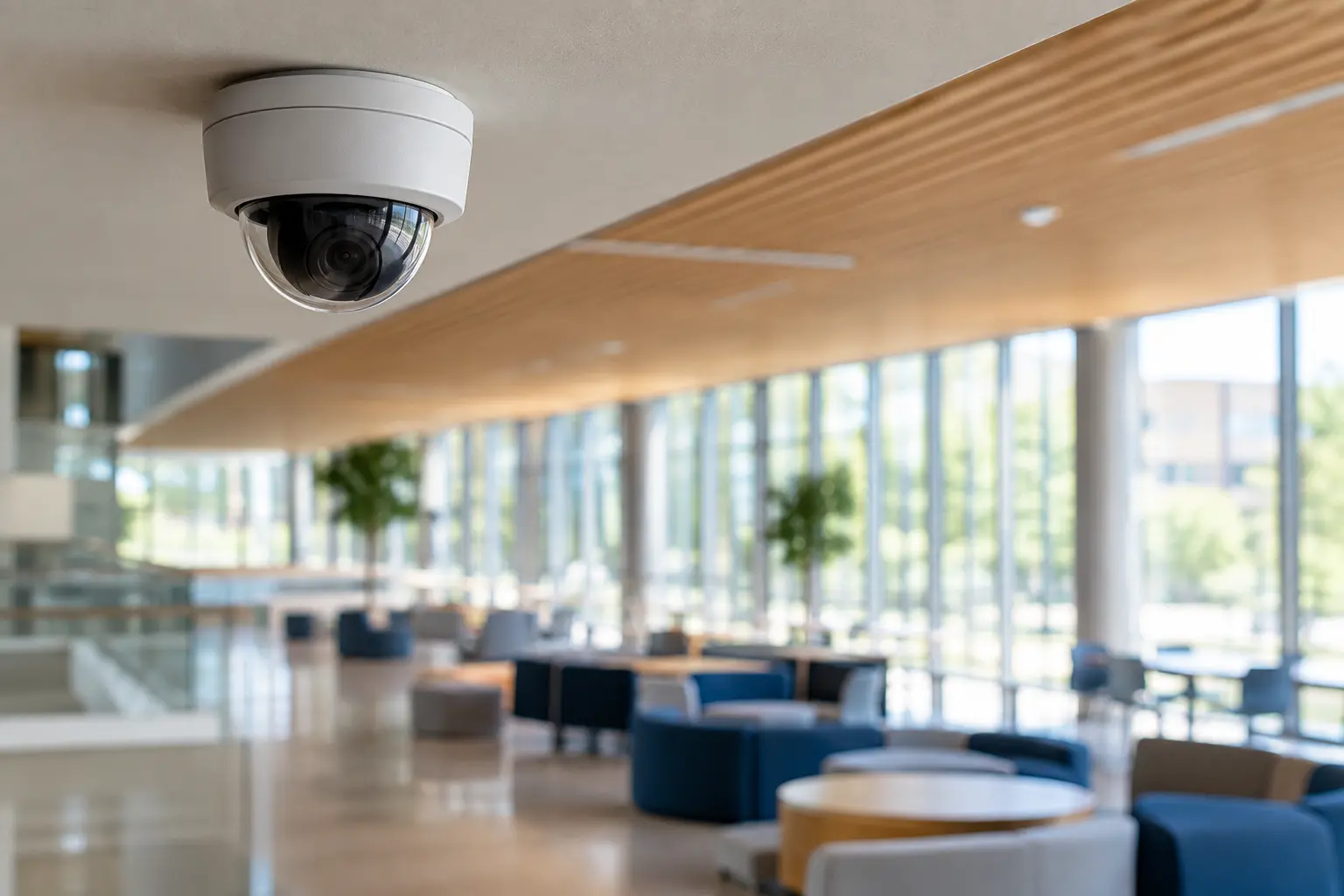
The Core Definition
A cognitive campus is a campus environment that uses artificial intelligence, Internet of Things sensors, and analytics to sense what's happening across buildings and grounds, interpret that data in context, and automate or recommend responses. The defining characteristic is integration: instead of separate systems for video surveillance, access control, emergency notification, and facilities management, a cognitive campus connects these layers so they inform each other.
When a door is forced open after hours, the system doesn't just log an access event. It checks nearby camera feeds, identifies whether the person is a known student or staff member, cross-references the building's occupancy status, and alerts security with a prioritized notification that includes video, location, and context. That's the difference between a collection of smart devices and a cognitive system.
The term "cognitive" refers to the system's ability to reason about what it observes. Machine learning models trained on campus behavior patterns can distinguish routine activity from anomalies, reduce false alarms, and surface actionable alerts. The goal is to move from reactive monitoring to proactive awareness.
The Technology Stack
What is a cognitive campus built on? Five core technology layers work together:
- IoT sensors and devices: cameras, access readers, environmental sensors, occupancy detectors, emergency call stations, and network-connected building systems
- Edge and cloud computing: edge devices process data locally for low-latency decisions; cloud platforms handle storage, training, and cross-building analytics
- AI and machine learning: video analytics, behavior modeling, anomaly detection, natural language processing for incident reports, and predictive maintenance algorithms
- Data integration middleware: APIs, data lakes, and integration platforms that normalize and fuse data from disparate systems
- Command and control interfaces: dashboards, mobile apps, and automated workflows that present insights and enable coordinated response
The stack isn't theoretical. According to Omdia, U.S. educational security spending surpassed $3.1 billion and was projected to grow more than 8% (Omdia, 2022) annually, with the broader school-and-campus security market valued around $4.2 billion (Omdia, 2022). That growth reflects institutions moving from standalone cameras and alarms to integrated, analytics-driven platforms.
How Is a Cognitive Campus Different from a Smart Campus?
Smart Campus: Connected Infrastructure
A smart campus connects devices and systems to improve efficiency and convenience. Smart lighting adjusts based on occupancy. Digital wayfinding helps visitors manage buildings. Energy management systems optimize HVAC based on real-time usage. These are valuable upgrades, but they're largely operational and often siloed by function.
Smart campus initiatives typically focus on student experience, sustainability, and cost reduction. The systems are connected, but they don't necessarily reason together. A smart thermostat doesn't know that a building is locked down during an emergency, and a smart parking system doesn't alert security when a vehicle enters a restricted zone after hours.
Cognitive Campus: Contextual Intelligence
What is a cognitive campus in contrast? It adds a reasoning layer on top of connected infrastructure. The system doesn't just collect data; it interprets it in context and triggers coordinated actions. When a fire alarm activates, a cognitive campus can automatically unlock exit doors, display evacuation routes on digital signage, send location-aware alerts to occupants, notify first responders with building details, and pull up relevant camera feeds in the security operations center.
The difference is integration depth and decision support. A smart campus makes individual systems more efficient. A cognitive campus makes the entire environment more aware and responsive. The cognitive layer fuses physical security, cyber security, and operational data so that an event in one domain informs actions in another.
What Are the Core Use Cases for a Cognitive Campus?
Physical Security and Emergency Response
Physical security is the most visible cognitive campus use case. Video analytics detect weapons, identify unauthorized access, and flag unusual behavior patterns. Access control systems cross-reference credentials against real-time threat intelligence. Emergency notification platforms send location-aware alerts based on where people actually are, not where they're supposed to be.
Texas law (Senate Bill 11, 2019; Texas Education Code Sec. 37.115) requires every school district board to establish a safe and supportive school program team that conducts behavioral threat assessments for each campus (Texas School Safety Center, 2019). A cognitive campus supports that mandate by centralizing incident data, tracking behavioral indicators across systems, and surfacing patterns that might otherwise go unnoticed.
When an incident occurs, responders need more than a 911 call. They need building layouts, camera feeds, occupancy counts, and real-time situational awareness. Texas HB 3 (88th Legislature, 2023) requires school districts to provide an accurate map of each district campus and building to first responders, codified in the Texas Education Code with a September 1, 2023 effective date (Texas School Safety Center, 2023). A cognitive campus delivers that map as a live, data-enriched view of the facility.
Cybersecurity and Network Visibility
Every connected device is a potential entry point for attackers. A cognitive campus treats network security as part of the physical security equation. Device profiling identifies every endpoint on the network. Zero trust architecture segments traffic so that a compromised camera can't access student records. Behavioral analytics flag unusual network activity that might indicate a breach.
The cyber-physical convergence is real. A cognitive campus monitors both domains and correlates events. If an access control system starts behaving erratically and network logs show unusual traffic from that device, the system alerts IT and security simultaneously. That kind of cross-domain awareness is difficult to achieve with siloed teams and tools.
What Technologies Power a Cognitive Campus?
AI and Video Analytics
Artificial intelligence is the engine of cognitive campus operations. Video analytics detect objects, recognize faces (where legally permitted and policy-compliant), identify weapons, and flag unusual behavior. Machine learning models trained on campus-specific data reduce false alarms by learning what normal activity looks like in each location.
AI also powers predictive maintenance. Sensors on HVAC systems, elevators, and other infrastructure feed data into models that predict failures before they happen. That shifts facilities teams from reactive repairs to scheduled maintenance, reducing downtime and costs.
IoT Sensors and Edge Computing
IoT sensors are the nervous system of a cognitive campus. They capture data on occupancy, environmental conditions, equipment status, and security events. Edge computing processes that data locally, enabling real-time decisions without round-tripping to the cloud.
Edge devices handle time-sensitive tasks like video analytics and access control. Cloud platforms handle long-term storage, model training, and cross-building analytics. The hybrid architecture balances latency, bandwidth, and cost.
| Technology Layer | What It Does | Impact on Operations |
|---|---|---|
| Video analytics | Detects objects, behaviors, and anomalies in camera feeds | High: reduces false alarms and surfaces actionable alerts |
| Access control integration | Cross-references credentials, occupancy, and threat intelligence | High: automates lockdowns and tracks unauthorized access |
| IoT sensors | Monitors environmental conditions, occupancy, and equipment status | Medium: supports predictive maintenance and space optimization |
| Data integration middleware | Fuses data from disparate systems into a unified view | High: enables cross-domain correlation and automated workflows |
| Edge computing | Processes time-sensitive data locally for low-latency decisions | Medium: reduces bandwidth costs and improves response time |
See your building the way a first responder needs to.
Ark builds an operational digital twin of your facility from a single capture, so your team and responders can prepare, route, and defend every decision. Schedule a Demo.
What Are the Privacy and Governance Challenges?
Privacy Risks and Compliance
A cognitive campus collects vast amounts of data about people's movements, behaviors, and activities. That raises legitimate privacy concerns. Students, staff, and visitors have a right to know what's being collected, how it's used, and who has access.
Privacy governance starts with transparency. Institutions should publish clear policies on data collection, retention, and use. Access to sensitive data should be role-based and audited. Video analytics that identify individuals require especially careful handling, and some jurisdictions restrict or ban facial recognition in educational settings.
Compliance frameworks like FERPA (for student records) and state privacy laws set boundaries. A cognitive campus must be designed with privacy by default: collect only what's needed, retain it only as long as required, and secure it against unauthorized access.
Data Governance and Interoperability
What is a cognitive campus without governance? A liability. Data from multiple systems must be normalized, secured, and governed consistently. That requires clear ownership, data standards, and integration protocols.
Interoperability is a persistent challenge. Legacy systems often use proprietary protocols that resist integration. Open standards like ONVIF for video and OSDP for access control help, but full interoperability remains a work in progress. Institutions should prioritize vendors that support open APIs and avoid lock-in.
How Do You Build a Cognitive Campus?
Start with a Pilot and Scale Incrementally
Building a cognitive campus doesn't happen overnight. The most successful deployments start with a pilot project focused on a specific use case: video analytics in high-traffic areas, integrated access control in a single building, or occupancy monitoring in a residence hall.
The pilot proves the technology, tests integration workflows, and builds institutional buy-in. Once the pilot delivers measurable results, the platform scales to additional buildings and use cases. Incremental deployment reduces risk and allows teams to learn as they go.
- Identify a high-value use case with clear success metrics
- Select a pilot location with existing infrastructure and stakeholder support
- Integrate 2-3 systems to demonstrate cross-domain correlation
- Measure outcomes: response time, false alarm reduction, incident resolution
- Document lessons learned and refine the integration playbook
- Scale to additional buildings and use cases based on pilot results
Establish Governance and Training
Technology alone doesn't create a cognitive campus. People and processes matter just as much. Establish a governance committee with representatives from security, IT, facilities, legal, and student affairs. Define roles, responsibilities, and escalation procedures.
Training is critical. Security operators need to understand how AI analytics work and when to trust or override automated recommendations. IT teams need to manage network segmentation and device visibility. Facilities staff need to interpret occupancy and maintenance alerts. Cross-functional training ensures everyone understands how the systems work together. Emergency call stations and panic buttons, mandated in several states under Alyssa's Law, integrate directly into cognitive campus alert workflows.
What Changes When You Deploy a Living Digital Twin?
From Static Maps to Contextual Awareness
Traditional campus maps are static drawings, often out of date the moment they're printed. A cognitive campus built on a living digital twin changes that. Ark Strategic provides a geospatially and contextually aware digital twin of the building and its lifecycle, created through lidar and camera capture with proprietary point cloud processing, enriched with cloud meshes and integrated data layers.
The twin isn't a frozen snapshot. It's a living model that reflects the facility as it exists today, with the ability to re-capture at intervals and compare captures over time. That means you can assess a site inside the twin instead of walking it, identify coverage gaps before deploying cameras, and model evacuation routes against the building's real geometry.
Routing and Simulation Against Real Geometry
What is a cognitive campus without accurate routing? A collection of alerts with no clear path to resolution. Ark's platform supports routing inside the twin via Ark Scenario: optimizing responder entry routes, modeling evacuation flow against the building's real geometry, identifying choke points, and pre-positioning responder staging.
That's not turn-by-turn navigation on a responder's device. It's routing within the simulation and the twin, allowing incident commanders to plan and brief before responders enter the building. The difference is preparation: instead of discovering a locked stairwell or blocked corridor during an active incident, you identify it in advance and adjust the plan.
Camera and Sensor Coverage Pinned to the Twin
Deploying cameras and sensors without a spatial reference leads to coverage gaps and redundant installations. Ark's platform pins each camera and sensor to the twin, showing per-device coverage gaps and overlaps. You see exactly what each camera can and cannot see, where blind spots exist, and where additional coverage is needed.
Live feeds display in the same view as the twin, so operators see the building and the video together. That spatial context reduces the time it takes to locate an incident and coordinate a response. Instead of cycling through camera feeds to find the right view, operators see the incident location on the twin and pull up the relevant cameras immediately.
Re-Capture and Lifecycle Comparison
Buildings change. Renovations add walls, remove doors, and reconfigure spaces. A static map becomes obsolete. Ark's approach supports re-capture at intervals, allowing you to compare captures over time and update the twin to reflect the building's current state.
That lifecycle awareness matters for compliance, too. Texas HB 3 requires accurate maps for first responders. An accurate map isn't a one-time deliverable; it's a commitment to keep the map current as the building evolves. A living digital twin makes that commitment achievable.
The Bottom Line
What is a cognitive campus? It's a campus environment where AI, IoT, and analytics work together to sense events, interpret context, and support coordinated responses. The defining characteristic is integration: physical security, cyber security, and operational data fuse into a unified intelligence layer that reduces noise, surfaces actionable alerts, and equips responders with the context they need.
The technology stack is proven. The use cases are clear. The biggest barriers are governance, interoperability, and the institutional will to move from siloed systems to integrated platforms. Institutions that start with a focused pilot, establish clear governance, and scale incrementally see measurable improvements in response time, incident resolution, and operational efficiency.
A cognitive campus isn't a product you buy. It's a capability you build, one integration at a time, with privacy and governance baked in from the start. The result is a campus that doesn't just collect data but reasons about it, supporting safer, faster, more informed decisions when it matters most.
Frequently Asked Questions
What is a cognitive campus and how does it differ from a smart campus?
A cognitive campus uses AI and analytics to interpret data in context and trigger coordinated responses, while a smart campus connects devices to improve efficiency. The cognitive layer adds reasoning and cross-domain correlation that smart infrastructure alone doesn't provide.
What technologies are required to build a cognitive campus?
Core technologies include IoT sensors, video analytics, AI and machine learning, edge and cloud computing, data integration middleware, and command-and-control interfaces. The key is integration: systems must share data and inform each other's decisions.
How much does a cognitive campus cost to deploy?
Costs vary widely based on campus size, existing infrastructure, and use cases. A pilot project in a single building might cost $50,000 to $200,000. Full campus deployment can range from hundreds of thousands to millions of dollars, depending on scope and integration complexity.
What are the biggest privacy risks with a cognitive campus?
Privacy risks include unauthorized data access, excessive surveillance, and misuse of behavioral analytics. Mitigation requires transparent policies, role-based access controls, data minimization, and compliance with FERPA and state privacy laws. Facial recognition requires especially careful governance.
Can I build a cognitive campus with existing infrastructure?
Yes, if your existing systems support open APIs and integration protocols. Legacy systems with proprietary protocols may require middleware or replacement. Start with a pilot to test integration feasibility, then scale based on what works with your current infrastructure.