The short answer: Behavioral threat assessment is a multidisciplinary team process that identifies, evaluates, and manages individuals who may pose a threat of targeted violence. The process relies on structured inquiry, evidence-based risk evaluation, and coordinated intervention planning. Three variables move the needle: early identification through bystander reporting, multidisciplinary team composition, and ongoing case management. As of April 2024, 85% (IES) of US public schools had a behavioral threat assessment team or other formal group, up from 82% in 2022-23 (IES).
Every K-12 school attacker studied by the Secret Service exhibited concerning behaviors before their attack, and in 80% of cases the behavior elicited concern from bystanders regarding the safety of the attacker or those around them (U.S. Secret Service National Threat Assessment Center, 2019). That single finding reshaped how schools, campuses, workplaces, and public-safety agencies approach violence prevention. Behavioral threat assessment emerged as the evidence-based answer: a structured, team-driven process to identify individuals of concern, assess the nature and severity of the threat, and manage risk through coordinated intervention.
This article explains how behavioral threat assessment works across K-12 schools, higher education, healthcare, and law enforcement settings. You'll see the core framework, team structures, legal considerations, and the operational realities that determine whether a program succeeds or stalls. The goal is to give practitioners and decision-makers a clear picture of what the discipline requires and how spatial context fits into the management phase.
What Is Behavioral Threat Assessment and How Does It Work?
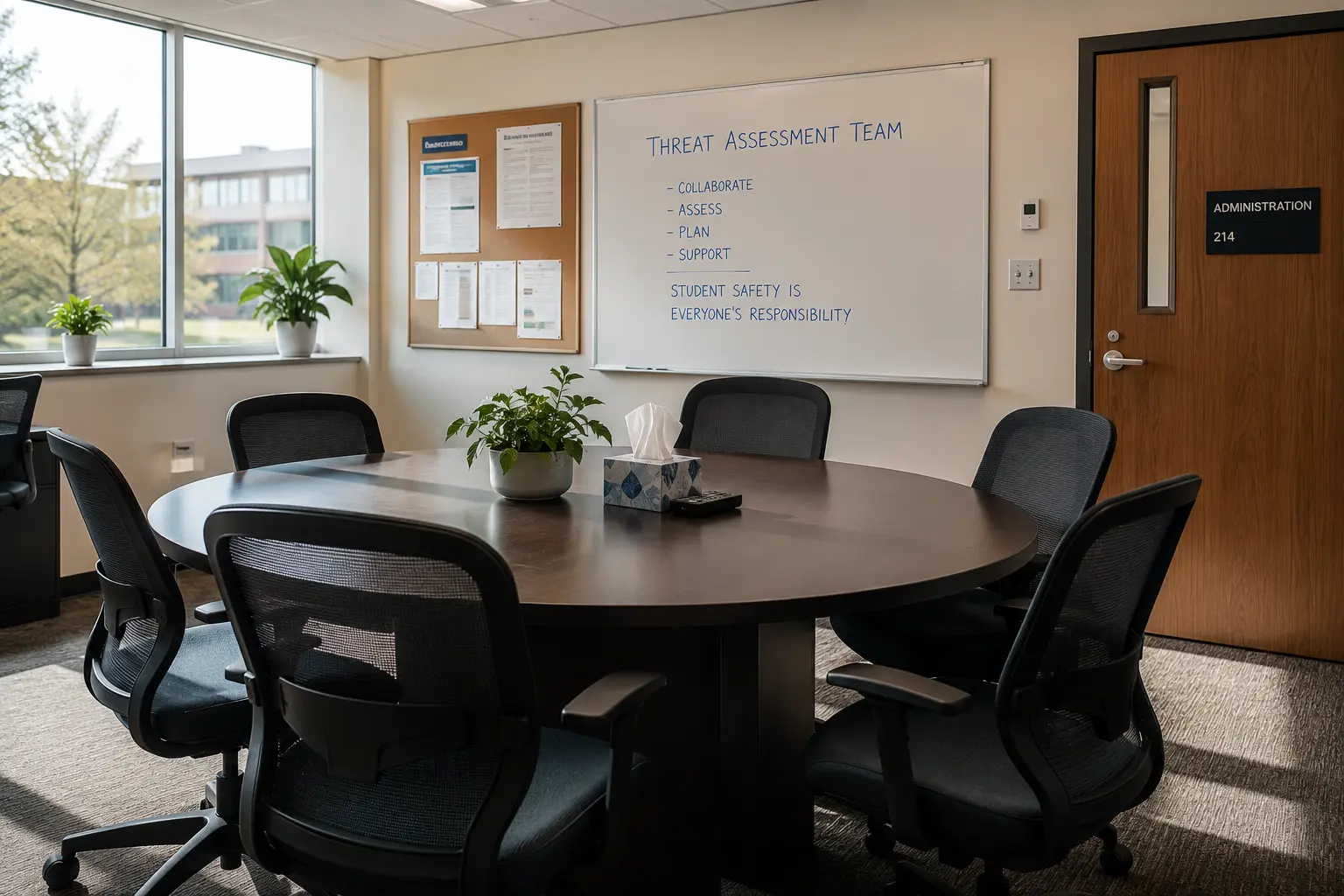
Behavioral threat assessment is a fact-based investigative and intervention process designed to identify, evaluate, and manage individuals who may pose a threat of targeted violence. It is not profiling, discipline, or criminal investigation. The process focuses on observable behaviors and circumstances rather than demographic traits or assumptions. A behavioral threat assessment team gathers information, evaluates whether a threat exists, determines its severity, and develops a management plan to reduce risk.
The U.S. Secret Service National Threat Assessment Center analyzed 67 averted plots to attack schools between 2006 and 2018, finding that bystander reporting of concerning behavior is what prevented them (U.S. Secret Service NTAC, 2021). That research underscores the discipline's foundation: targeted violence is often preventable when concerning behaviors are recognized, reported, and acted upon by a trained team.
The Core Framework: Identify, Assess, Manage
Most behavioral threat assessment programs follow a three-phase framework. The identification phase establishes reporting channels so students, staff, patients, employees, or community members can share concerns. Schools use tip lines, apps, website forms, and direct reports to administrators. Healthcare systems integrate reporting into workplace violence prevention programs. Law enforcement agencies coordinate with schools, mental health providers, and community organizations to surface information.
The assessment phase evaluates the credibility and severity of the reported behavior. The team asks: Does the behavior pose a threat? A threat of what, by whom, toward whom, and when? Assessment is not a checklist or a score. It is a structured inquiry that examines the individual's statements, actions, access to weapons, grievances, planning behaviors, and capacity to carry out violence. Teams use validated frameworks and consult subject-matter experts as needed.
The management phase develops and implements interventions to reduce risk. Interventions range from mental health support and family engagement to access restrictions, law enforcement involvement, and ongoing monitoring. Management is not a one-time event. Cases remain open as long as risk factors persist, and teams adjust plans as circumstances change.
What Behavioral Threat Assessment Is Not
Behavioral threat assessment is not a disciplinary process. A student who makes a threatening statement may need both a threat assessment and a disciplinary consequence, but the two processes serve different purposes. Discipline addresses rule violations. Threat assessment addresses safety risk. Conflating the two undermines reporting and trust.
It is not profiling. Profiling attempts to predict violence based on demographic or personality traits. Research shows that approach does not work. Behavioral threat assessment examines specific behaviors and situations, not categories of people. It is also not a guarantee. Even well-executed programs cannot prevent every incident. The goal is to reduce risk through early intervention and coordinated response.
Who Sits on a Behavioral Threat Assessment Team?
Effective behavioral threat assessment requires a multidisciplinary team with diverse expertise. No single role has the full picture. A school counselor may recognize a student's mental health crisis, but lack visibility into social media activity. A security officer may observe concerning behavior on campus, but lack clinical training to assess suicide risk. The team structure brings those perspectives together.
In the 2021-22 school year, 65% (NCES, 2021) of all US public schools reported having a threat assessment team (National Center for Education Statistics, 2024). That figure masks wide variation in team composition, training, and operational maturity. Some teams meet weekly with clear protocols. Others convene reactively and lack documentation standards.
K-12 School Team Composition
A typical K-12 behavioral threat assessment team includes a school administrator (often the principal or assistant principal), a mental health professional (school psychologist, counselor, or social worker), a school resource officer or law enforcement liaison, and at least one teacher or instructional staff member. Larger districts may add a district-level coordinator, legal counsel, and a community mental health partner.
The administrator provides decision-making authority and coordinates with district leadership. The mental health professional conducts clinical assessments, evaluates suicide risk, and recommends support services. The law enforcement member advises on criminal conduct, weapons access, and coordination with external agencies. The teacher or staff member offers insight into the student's daily behavior, peer relationships, and academic context. Each role is essential. A team missing any of these perspectives operates with blind spots.
Healthcare, Higher Education, and Law Enforcement Teams
Healthcare behavioral threat assessment teams typically include security leadership, human resources, risk management, clinical staff (psychiatry, social work), and legal counsel. The team addresses threats from patients, family members, and employees. Hospital systems face unique challenges: open campuses, high-stress clinical environments, and regulatory requirements from The Joint Commission and OSHA.
Higher education teams mirror K-12 structures but add student conduct officers, residence life staff, and Title IX coordinators. Campus teams manage a wider age range, more complex legal considerations around privacy and due process, and coordination across multiple departments. Law enforcement behavioral threat assessment units bring together detectives, intelligence analysts, mental health professionals, and prosecutors. These units handle cases that cross jurisdictions and require sustained investigation.
Need help building spatial context into your threat assessment program? Contact Ark Strategic to see how a living digital twin supports the management phase.
How Do You Identify Concerning Behaviors?
Identification is the entry point for every behavioral threat assessment case. Without effective reporting mechanisms, teams never learn about individuals of concern until an incident occurs. When people observed an active shooter's concerning behavior, the most common responses were to confront the shooter directly or do nothing; only 41% of cases saw a report to law enforcement (FBI, 2018). That gap between observation and reporting is where prevention fails.
Concerning behaviors fall into several categories. Direct threats are explicit statements of intent to harm someone or damage property. Indirect threats are veiled, conditional, or ambiguous statements that suggest harm. Leakage occurs when an individual communicates intent to a third party, often through social media, journals, or conversations with peers. Other warning signs include fixation on violence or violent figures, research into weapons or attack methods, sudden isolation or withdrawal, and expressions of hopelessness or suicidal ideation.
Building Reporting Channels That People Actually Use
Effective reporting requires multiple channels. Students may not report to a teacher but will use an anonymous tip line. Employees may hesitate to approach HR but will call a 24/7 hotline. Schools use apps, web forms, email addresses, posters with QR codes, and direct outreach during assemblies. Healthcare systems integrate reporting into workplace violence prevention training and incident reporting systems. The key is accessibility and trust.
Anonymous reporting is valuable but insufficient on its own. Teams need follow-up information to assess credibility and context. Hybrid systems allow initial anonymous reports with optional follow-up contact. Training is equally important. Staff, students, and community members must understand what to report, how to report, and what happens after a report is made. Many people stay silent because they fear overreacting, getting someone in trouble, or being ignored.
Distinguishing Prohibited Behaviors from Concerning Behaviors
Not every concerning behavior rises to the level of a threat. A student who writes a violent story in creative writing class may need support, but not necessarily a full threat assessment. A patient who yells at a nurse during a medical crisis is exhibiting concerning behavior, but the context matters. Teams use triage protocols to distinguish between behaviors that require immediate assessment, behaviors that warrant monitoring, and behaviors best addressed through other channels like counseling or conflict resolution.
Texas law (Senate Bill 11, 2019; Texas Education Code Sec. 37.115) requires every school district board to establish a safe and supportive school program team that conducts behavioral threat assessments for each campus (Texas School Safety Center, 2019). That mandate reflects a broader trend: states are moving from optional guidance to legal requirements. Eleven states have laws requiring in-school threat assessment teams, per Everytown's state law rankings (Everytown for Gun Safety Support Fund, 2026).
| Factor | What it is | Impact |
|---|---|---|
| Multiple reporting channels | Anonymous tips, apps, direct reports, hotlines | High |
| Staff and student training | What to report, how to report, what happens next | High |
| Triage protocols | Distinguish immediate threats from lower-concern behaviors | Medium |
| Follow-up mechanisms | Ability to gather additional information after initial report | Medium |
| Trust and confidentiality | Clear communication about privacy and outcomes | High |
What Does the Assessment Phase Look Like?
Assessment is where behavioral threat assessment teams move from concern to evidence-based evaluation. The team gathers information, interviews relevant parties, and determines whether the individual poses a threat and at what level of severity. This phase is investigative, not punitive. The goal is to understand the situation fully before deciding on a course of action.
Teams use structured frameworks to guide assessment. Common models include the Comprehensive School Threat Assessment Guidelines, the Structured Professional Judgment approach, and frameworks developed by the FBI and Secret Service. These tools provide consistency and reduce the risk of bias. They do not generate a numerical score or a binary yes/no answer. Instead, they help teams organize information and identify gaps.
Core Questions Every Assessment Must Answer
The assessment phase revolves around several core questions. Does the reported behavior constitute a threat? If yes, is it a threat of violence, self-harm, or something else? Who is the subject of concern, and who is the target? What is the timeline, imminent, near-term, or longer-term? What evidence supports the concern, and what contradicts it?
Teams also evaluate the individual's capacity and intent. Capacity includes access to weapons, knowledge of the target's routines, and physical or logistical ability to carry out violence. Intent is harder to assess. Teams look for planning behaviors, research into attack methods, rehearsal or preparation, and statements of intent. They also consider protective factors: strong family support, engagement in school or work, access to mental health services, and positive peer relationships.
Information Sources and Privacy Considerations
Assessment requires information from multiple sources. Teams review the initial report, interview the subject of concern (when safe and appropriate), speak with witnesses, consult with family members, and examine social media, journals, or other communications. In schools, teams review academic records, attendance patterns, and disciplinary history. In workplaces, teams may consult HR files and performance reviews.
Privacy laws shape what information teams can access and share. In K-12 schools, FERPA governs student records. In healthcare, HIPAA limits disclosure of patient information. In higher education, both FERPA and Title IX apply. Teams must balance the need for information with legal obligations and the individual's rights. Legal counsel should be involved early, especially in complex cases.
How Do Teams Manage Risk After Assessment?
The management phase is where behavioral threat assessment moves from evaluation to action. Once the team determines that a threat exists and assesses its severity, they develop a plan to reduce risk. Management is not a single intervention. It is an ongoing process that adapts as circumstances change. Cases remain open as long as risk factors persist.
Management strategies fall into several categories. Mental health interventions include counseling, psychiatric evaluation, crisis intervention, and referrals to community providers. Family engagement brings parents or guardians into the process, shares concerns, and enlists their support. Access restrictions limit the individual's proximity to potential targets or weapons. In schools, this might mean a schedule change or supervised transitions. In workplaces, it might mean a leave of absence or termination.
Coordinating with Law Enforcement and External Agencies
Some cases require law enforcement involvement. If the individual has made a credible threat of violence, possesses weapons illegally, or has committed a crime, law enforcement must be notified. The threshold for law enforcement involvement varies by jurisdiction and context. School-based teams coordinate with school resource officers or local police. Healthcare teams work with hospital security and municipal law enforcement. Campus teams may involve campus police, local police, or both.
External agencies also play a role. Mental health providers, child protective services, probation officers, and community organizations may all be part of the management plan. Coordination requires clear communication, defined roles, and shared documentation. Many cases fail not because the team lacked a plan, but because the plan was never implemented or no one followed up.
Monitoring, Documentation, and Case Closure
Ongoing monitoring is essential. Teams schedule regular check-ins, review new information, and adjust the management plan as needed. Documentation protects the team, the organization, and the individual. Every report, interview, assessment, and intervention should be recorded in a secure, confidential system. Documentation also supports accountability and continuous improvement.
Case closure occurs when risk factors have been resolved or sufficiently mitigated. Closure does not mean the individual is no longer a concern forever. It means the current threat has been addressed and active management is no longer required. Some cases close after a few weeks. Others remain open for months or years. Teams should have clear criteria for closure and a process for reopening cases if new concerns arise.
See your building the way a first responder needs to.
Ark builds an operational digital twin of your facility from a single capture, so your team and responders can prepare, route, and defend every decision. Schedule a Demo.
What Role Does Physical Context Play in Threat Management?
Most behavioral threat assessment discussions focus on the human elements: team composition, reporting, clinical evaluation, and intervention planning. Those elements are foundational. But every threat assessment case eventually lands in a physical building. The management phase requires spatial and operational context that most teams lack.
Consider a high school threat assessment case. The team has identified a student of concern, assessed the threat as moderate, and developed a management plan that includes supervised transitions, limited access to certain areas, and coordination with the school resource officer. The plan is sound on paper. But the building has three wings, multiple stairwells, and exterior doors that are sometimes propped open. The team is working from a 2D floor plan drawn five years ago, before the recent renovation. No one on the team has a shared, current view of the building as it exists today.
The Gap Between Planning and Physical Reality
Threat assessment teams make decisions about access, exposure, sightlines, staging areas for drills, and briefing responders. Those decisions are inherently spatial. Yet most teams operate against flat, stale artifacts: 2D floor plans, PDFs, and someone's memory of what a wing looks like. When a team needs to evaluate whether a student can access a particular classroom unobserved, or where to stage law enforcement during a drill, they are guessing.
That gap widens in complex facilities. A hospital with multiple buildings, a university campus with dozens of structures, or a K-12 district with aging infrastructure and incremental additions all present the same challenge. The protective plan is only as good as the physical context it is built on. If the context is outdated or incomplete, the plan is unreliable.
How a Living Digital Twin Supports the Management Phase
Ark Strategic provides the spatial and operational layer that a behavioral threat assessment program acts upon. The platform is a living, geospatially and contextually aware digital twin of the facility and its lifecycle. Capture teams use lidar and various camera technologies to scan the building. Proprietary point cloud processing, cloud meshes, and integrated data layers produce a model that reflects the building as it stands today, not as it was drawn. Alphanumeric grid overlays and gridded facility maps are available on request. RTK-derived latitude and longitude anchor the exterior twin. Where a site calls for it, 3D Gaussian Splats can be layered on.
That living twin gives threat assessment and management teams current, shared physical context for the parts of a protective plan that are inherently spatial. Teams can evaluate exposure and sightline or vantage analysis, identify access points, plan staging areas for drills, and brief responders on the building as it exists today. The twin is not a static map. It is a lifecycle model that evolves as the facility changes.
Ark does not perform behavioral threat assessment. It does not analyze or score individuals. It does not provide case-management software. It is a preparedness and context layer, not an outcome guarantee. The platform supports the management phase by giving teams the spatial foundation their protective plans require.
What Are the Legal and Ethical Boundaries?
Behavioral threat assessment operates at the intersection of safety, privacy, and individual rights. Teams must balance the need to protect the community with the individual's right to due process, confidentiality, and fair treatment. Legal and ethical missteps can expose the organization to liability, undermine trust, and harm the individual.
Privacy laws are the first boundary. In K-12 schools, FERPA restricts disclosure of student education records. Teams can share information within the school on a need-to-know basis, but external disclosure requires consent or a legal exception. In healthcare, HIPAA limits disclosure of patient information. Threat assessment teams can share information necessary to prevent imminent harm, but the disclosure must be narrowly tailored. In higher education, both FERPA and Title IX apply, along with state laws governing adult students.
Due Process and Avoiding Discrimination
Due process requires that individuals receive notice and an opportunity to respond before adverse action is taken. In schools, this means the student and family should be informed of the concern and given a chance to provide their perspective. In workplaces, employees have similar rights under employment law. The process must be fair, consistent, and documented.
Discrimination is a persistent risk. Behavioral threat assessment must focus on behaviors, not demographics. Research shows that profiling based on race, religion, or other protected characteristics does not predict violence and violates civil rights. Teams must guard against implicit bias and ensure that reporting and assessment processes are applied equitably. Training on bias, cultural competence, and legal obligations is essential.
When to Involve Legal Counsel
Legal counsel should be involved early in complex cases. If the case involves a potential crime, a minor, a protected class, or a high-profile individual, consult legal counsel before taking action. Counsel can advise on privacy obligations, due process requirements, and potential liability. They can also help draft policies, review documentation practices, and represent the organization if a case leads to litigation.
Ethical obligations go beyond legal compliance. Teams have a duty to act in good faith, avoid harm, and respect the dignity of the individual. That means not using threat assessment as a pretext for discipline or retaliation, not sharing information beyond what is necessary, and not stigmatizing individuals who have been assessed. The goal is safety, not punishment.
How Do You Train and Sustain a Behavioral Threat Assessment Program?
A behavioral threat assessment program is only as strong as the people who run it. Training is not a one-time event. It is an ongoing investment in team competence, organizational culture, and system resilience. Without training, teams revert to reactive, inconsistent responses. With training, they build institutional knowledge and improve over time.
Initial training should cover the fundamentals: the purpose and scope of behavioral threat assessment, the difference between threat assessment and discipline, team roles and responsibilities, reporting mechanisms, assessment frameworks, and legal and ethical obligations. Training should be role-specific. Administrators need different content than mental health professionals or law enforcement liaisons. Everyone needs a shared understanding of the process, but each role requires specialized skills.
Scenario-Based Training and Tabletop Exercises
Scenario-based training is the most effective way to build competence. Teams work through realistic cases, practice gathering information, conduct mock assessments, and develop management plans. Scenarios should vary in complexity and context. A low-level case involving a vague social media post requires different skills than a high-level case involving a credible threat with access to weapons.
Tabletop exercises bring the full team together to simulate a case from start to finish. The facilitator presents a scenario, and the team walks through each phase: identification, assessment, management, and follow-up. Exercises reveal gaps in communication, documentation, and coordination. They also build trust and familiarity among team members. Many teams discover during an exercise that they lack clarity on who makes final decisions or how to involve law enforcement.
Continuous Improvement and Program Audits
Behavioral threat assessment programs should be audited regularly. Audits review case files, assess compliance with policies and legal requirements, and identify areas for improvement. External audits by consultants or peer reviewers provide an objective perspective. Internal audits by district leadership or risk management ensure accountability.
Continuous improvement also requires feedback loops. Teams should debrief after every case, especially high-stakes cases. What went well? What could have been done differently? What information was missing? Debriefs are not blame sessions. They are learning opportunities. Programs that build a culture of reflection and adaptation outperform programs that treat threat assessment as a checklist.
The Bottom Line
Behavioral threat assessment is a multidisciplinary, evidence-based process that identifies, evaluates, and manages individuals who may pose a threat of targeted violence. It is not profiling, discipline, or a guarantee. It is a structured approach to early intervention and risk reduction. Effective programs require trained teams, clear reporting mechanisms, validated assessment frameworks, coordinated management plans, and ongoing monitoring.
The management phase of every behavioral threat assessment program eventually requires spatial and operational context. Most teams work from flat, outdated artifacts that limit their ability to plan, brief, and respond. A living digital twin provides the current, shared physical foundation that protective plans require. Ark Strategic is that spatial layer, captured using lidar and camera technologies, enriched with proprietary point cloud processing, cloud meshes, and integrated data layers, and delivered as a geospatially and contextually aware model of the facility and its lifecycle.
Behavioral threat assessment is a discipline that saves lives when done well. It requires investment, training, and institutional commitment. The teams that succeed are the ones that treat it as a core function, not an add-on.
Frequently Asked Questions
What is the difference between behavioral threat assessment and profiling?
Behavioral threat assessment focuses on specific observable behaviors and circumstances, not demographic traits or personality profiles. Profiling attempts to predict violence based on categories of people, an approach research shows does not work. Threat assessment is evidence-based and individualized.
Who should be on a behavioral threat assessment team?
A multidisciplinary team typically includes an administrator, mental health professional, law enforcement liaison, and instructional staff in schools. Healthcare teams add security, HR, risk management, and clinical staff. Higher education teams include student conduct and Title IX coordinators. Each role brings essential perspective.
How do I build a threat assessment program if I lack in-house expertise?
Start with training from established frameworks like the Comprehensive School Threat Assessment Guidelines or Secret Service NTAC resources. Bring in external consultants for initial setup, policy development, and scenario-based exercises. Partner with local law enforcement and mental health providers. Build internal capacity over time through ongoing training and case debriefs.
What happens after a behavioral threat assessment is complete?
The team develops a management plan tailored to the level of risk. Plans may include mental health support, family engagement, access restrictions, law enforcement involvement, and ongoing monitoring. Cases remain open as long as risk factors persist. The team adjusts the plan as circumstances change and closes the case when risk is mitigated.
Can a digital twin replace a threat assessment team?
No. A digital twin is a spatial and operational tool that supports the management phase of a behavioral threat assessment program. It provides current physical context for protective planning, drill staging, and responder briefings. It does not assess individuals, analyze behavior, or make intervention decisions. The team owns the process; the twin supports it.